



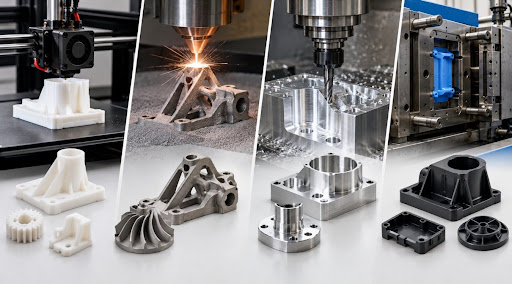
Choosing a manufacturing process is usually the decision that determines everything else about a project: how much it costs, how long it takes, and whether the part can even be made the way it’s designed. For businesses evaluating 3D printing Australia-wide alongside more traditional routes, the four processes that come up most often are plastic 3D printing, metal 3D printing, CNC machining, and injection moulding. Each one has a genuinely different cost structure and lead time, and the right choice usually comes down to one question: how many parts do you need, and how soon?
Quick answer: Plastic 3D printing and CNC machining both avoid tooling costs and suit low volumes, with 3D printing cheaper for complex geometry and CNC machining better for tight tolerances in metal. Metal 3D printing sits at a premium above both, justified by parts that would otherwise need expensive machining from solid billet. Injection moulding requires an upfront tooling investment that can run into the thousands of dollars and take weeks to produce, but once that mould exists, per-unit cost drops sharply at volume, which is why it only makes economic sense for larger production runs.
Plastic 3D Printing: Low Cost, No Tooling, Fast Turnaround
Plastic 3D printing covers a range of processes, FDM, SLA, SLS, MJF and PolyJet, each suited to a different balance of cost, finish and mechanical performance. What they share is the same basic economics: a design goes straight from a digital file to a finished part, with no mould or tooling required, which is why a single prototype and a short production run are quoted through the same process.
In practical terms, a small FDM prototype typically costs around A$30 to A$500, and can often ship within 24 hours. The more detailed or industrial-grade processes, SLA, SLS, MJF and PolyJet, generally run from A$50 up to A$2,000 for a one-off part, with turnaround of around 5 to 7 business days. Ordering a batch of 10 to 50 units brings the per-unit price down meaningfully, since setup and file preparation are spread across more parts.
Plastic 3D printing is the natural fit for rapid prototyping, low-volume functional parts, jigs and fixtures, and any design that would be expensive or impossible to tool for, particularly parts with internal channels, organic curves or lattice structures that a cutting tool can’t reach.
Metal 3D Printing: A Premium Justified by Geometry and Strength
Metal 3D printing, using processes such as DMLS and SLM, sits in its own cost tier. Metal powders such as titanium, stainless steel and Inconel cost substantially more than plastic materials, and the process typically includes post-processing such as heat treatment and support removal, which adds to both cost and lead time. A metal 3D printed part can start from around A$300 for something simple and climb well past A$10,000 for a large or complex component, with turnaround generally running 5 to 7 business days plus any additional finishing.
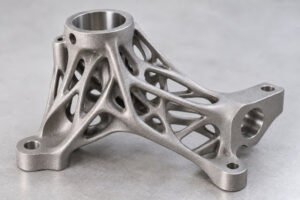
What justifies that premium is what metal 3D printing makes possible: complex internal geometry, significant weight reduction through lattice structures, and production of a single part or a handful of parts without the enormous cost of machining the same geometry from solid metal billet. It’s the process of choice for aerospace, defence and high-strength end-use components where performance matters more than unit cost.
CNC Machining Service: Precision Without Tooling, at a Price Per Part
A CNC machining service removes material from a solid block using a cutting tool, rather than building a part up layer by layer. Like 3D printing, it requires no mould or tooling investment, so a single machined part and a small batch are both achievable without the capital outlay injection moulding demands. That’s the main reason CNC machining and 3D printing are so often compared directly: both are economical at low volume, for different reasons.
Cost with CNC machining is driven primarily by machine time, material removal, and the complexity of the geometry, rather than by the weight of the finished part. A simple bracket machined from aluminium is relatively quick and affordable; a part with multiple setups, tight tolerances, or deep pockets takes longer and costs more, regardless of material. Lead times for CNC machining are typically measured in days rather than hours, though they scale with part complexity and the number of machine setups required.
CNC machining earns its place over 3D printing where a part needs metal properties a printed part can’t match cost-effectively, extremely tight tolerances, or a finish (threaded holes, precision bores) that’s simpler to machine than to print and post-process.
Injection Moulding Service: Tooling Investment, Then Low Cost at Volume
An injection moulding service works differently from the first three processes entirely. Molten plastic is injected into a custom-built mould, or tool, which is then reused to produce identical parts at high speed. That tool is the key economic variable: building it is a genuine upfront investment, and depending on the part’s complexity and the number of cavities in the mould, tool fabrication can take several weeks before the first production part is even possible.
Once that mould exists, though, the economics flip entirely in injection moulding’s favour. Per-unit cost drops sharply as volume increases, because the tooling cost is spread across every part produced from it, and cycle times per part are measured in seconds. This is why injection moulding essentially never makes sense for a single prototype, but becomes the clear cost leader once a project moves into genuine production volumes, typically thousands of units rather than tens or hundreds.
The Comparison at a Glance
| Process | Tooling required | Typical lead time | Best suited for |
| Plastic 3D printing | None | Hours to about a week | Prototypes, low-volume functional parts, complex geometry |
| Metal 3D printing | None | About a week, plus finishing | Complex metal geometry, aerospace/defence, single or small-batch parts |
| CNC machining service | None | Days, scaling with complexity | Tight tolerances, metal parts, precision features |
| Injection moulding service | Custom mould (weeks to build) | Long lead-in, then seconds per part | High-volume production runs |
How to Choose Between Them
The decision usually comes down to volume and geometry, in that order. For a single prototype or a handful of parts, plastic or metal 3D printing is almost always the fastest and most cost-effective route, since there’s no tooling to amortise. For low-to-medium volumes of a metal part with tight tolerances, a CNC machining service is often the better economic fit than metal 3D printing, provided the geometry doesn’t require features only additive manufacturing can produce. Injection moulding only earns its upfront tooling cost back once volumes climb high enough, generally production runs rather than prototyping or pilot batches.
A manufacturer running all four processes in-house, rather than specialising in just one, is in a position to recommend honestly across that decision rather than steering every job toward whichever machine happens to be available. That’s a meaningfully different conversation than getting a quote from a single-process shop, where the answer to “which process should I use” is rarely going to be “not us.”
This article was contributed by the team at Zeal 3D, an Australia-based manufacturer running plastic and metal 3D printing, CNC machining and injection moulding in-house, with 45+ materials, no minimum order quantity, and national delivery.
