



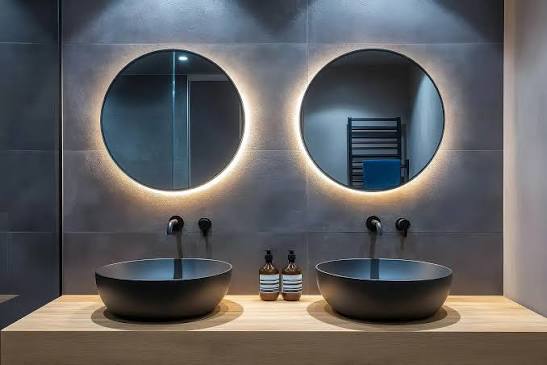
Walk into any bathroom showroom and led bathroom mirrors now outnumber traditional wall mirrors by a wide margin. That shift happened fast, and it happened for a practical reason: standard vanity lighting rarely gives an accurate read on skin tone, and a mirror with its own integrated light source solves that problem directly instead of relying on fixtures mounted somewhere else on the wall.
Why Lighting at the Mirror Changes Everything
Most bathroom lighting sits above or beside the mirror, which creates shadows across the face rather than even illumination. A light source built into the mirror frame itself eliminates that shadow problem because the light travels the same direction as the sightline.
This matters more than it sounds for a few practical reasons:
- Makeup application and shaving both depend on seeing true color and texture, not a shadowed approximation
- Morning and evening routines happen at different natural light levels, so a fixed-brightness mirror often feels wrong at one time of day or the other
- A poorly lit mirror pushes people toward phone flashlights or bringing a separate vanity light into the room, which defeats the purpose of the fixture
Once lighting sits at the mirror instead of above it, these workarounds mostly disappear, which is the real argument for making the switch.
Specs That Separate a Good Mirror From a Disappointing One
Not every LED mirror on the market delivers on the lighting promise. A handful of specifications determine whether the light is actually useful once installed:
- Color rendering index (CRI). A rating of 90 or higher renders skin tone and fabric color close to how they look in natural daylight; anything meaningfully lower can cast a flat or slightly artificial tone.
- Adjustable color temperature. A range between roughly 3000K and 6000K lets the same mirror shift from a warm evening tone to a brighter, cooler daytime setting.
- Dimming capability. Fixed-brightness mirrors work for exactly one lighting scenario; a dimmable version adapts across the day and reduces glare at night.
- Touch-sensor controls. A responsive touch panel on the glass itself is more durable long-term than a separate mechanical switch, which can loosen or fail with humidity exposure.
- Anti-fog coating. A heated anti-fog layer keeps the mirror surface clear after a hot shower, which matters more for an LED mirror since the light draws attention to any fogging.
Frame and mounting hardware matter just as much as the lighting itself. Stainless steel or aluminum resists warping better than composite materials in a consistently humid room, and soft-close hinges on cabinet-style versions prevent the sagging that cheaper spring hinges develop over time.
Installation Considerations Worth Planning For
Swapping a standard mirror for an LED version is more involved than a typical mirror replacement, since power has to reach the fixture. A few planning points prevent surprises mid-project:
- Power source. Some models plug into a nearby outlet, while others require a hardwired connection behind the wall; confirming which type before purchase avoids a mismatched installation.
- Weight and mounting hardware. LED mirrors with built-in electronics weigh more than plain glass; the wall anchors need to match that added weight, especially for larger sizes.
- Outlet or switch placement. If the mirror uses a plug-in cord, the outlet needs to sit close enough to stay hidden rather than running a visible cord across the wall.
- Dimmer compatibility. Not every dimmer switch works with every LED driver; checking compatibility before wiring prevents flickering or buzzing after installation.
- Ventilation timing. In a bathroom without strong exhaust ventilation, an anti-fog-equipped mirror performs noticeably better, so it’s worth prioritizing that feature if the fan is undersized.
DIY-friendly models typically include a wiring diagram and a straightforward mounting bracket, but anything requiring a hardwired connection is worth having an electrician confirm, particularly in an older bathroom with outdated wiring.
Matching the Mirror to the Room
Not every bathroom needs the same version of this fixture. A few practical distinctions help narrow the field:
- A single-vanity bathroom benefits most from a mirror with strong dimming range, since one person’s lighting needs shift throughout the day
- A shared or double-vanity bathroom often does better with two smaller mirrors rather than one oversized one, so each person controls their own settings
- A powder room with minimal daily use can prioritize appearance and basic brightness over advanced features like anti-fog
- A primary bathroom with heavy daily use justifies spending more on CRI rating, dimming, and build quality, since it gets used the most
Retailers such as Allsumhome list CRI, color temperature range, and power requirements directly on each product page, which makes it easier to compare these details before narrowing down a final choice.
The Bottom Line
The appeal of led bathroom mirrors is real, but the fixture only delivers on that promise when the lighting specs are actually good. A high CRI rating, a usable dimming range, and reliable anti-fog performance matter far more than how the mirror looks in a product photo. Spending a little extra time comparing those numbers before buying is what separates a mirror that genuinely improves the daily routine from one that just looks nice for the first few months.
